This summary was created with AI support from Demor Digital.
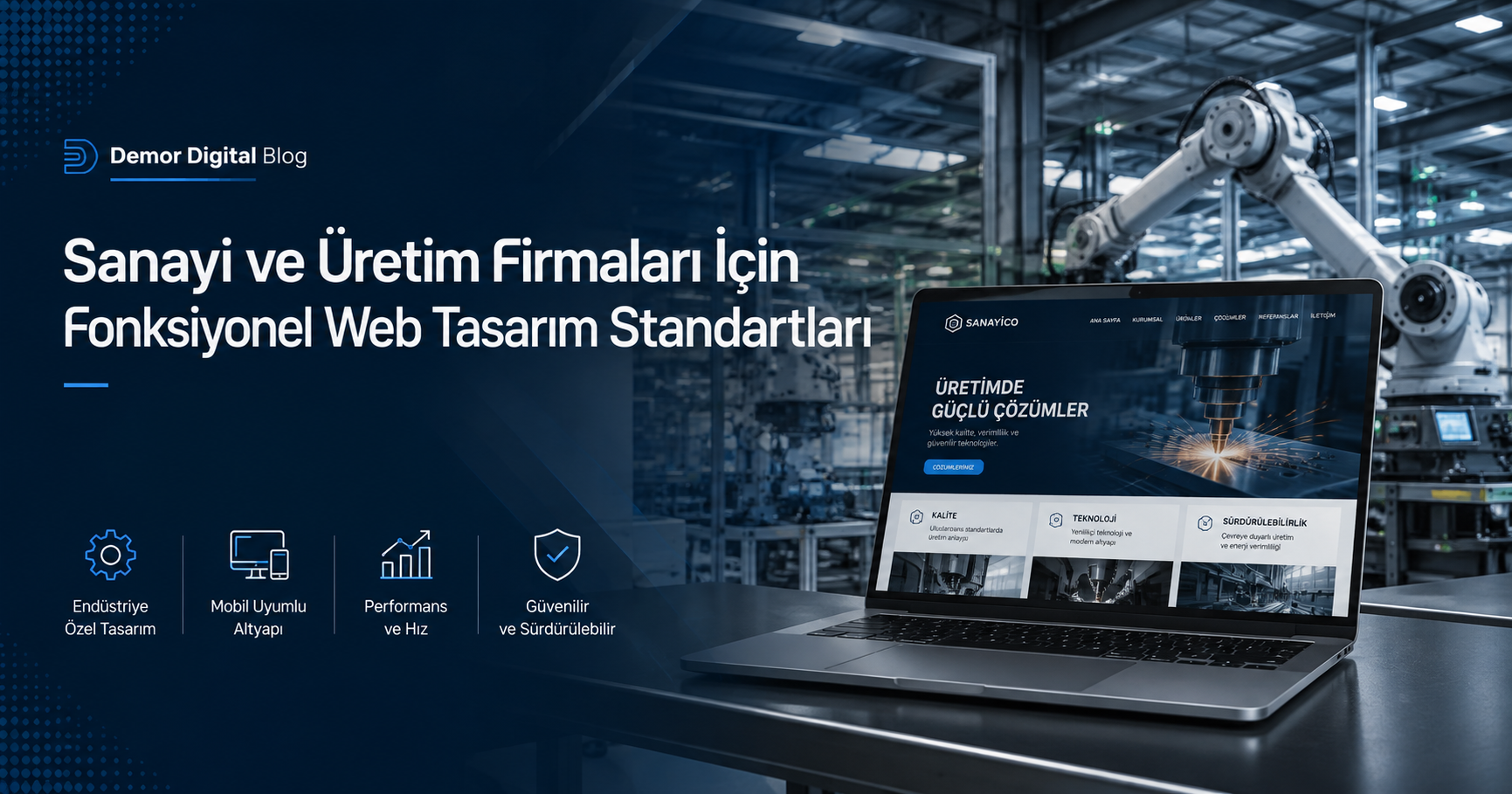
Functional Web Design Standards for Industrial and Manufacturing Companies — A manufacturing website should be more than a corporate showcase. With the right structure, it can present your products, strengthen credibility, support international sales, and generate qualified B2B inquiries.
Discover essential web design standards for industrial and manufacturing companies, including B2B UX, product catalogs, SEO, performance, security, and lead generation.
Summarize this article with a different AI tool:
Functional Web Design Standards for Industrial and Manufacturing Companies
For industrial and manufacturing companies, a website is no longer just a digital business card. Today, potential customers, distributors, suppliers, procurement teams, and international business partners often evaluate a company's digital presence before making direct contact.
Even a company with strong production capabilities may lose valuable business opportunities if its products, technical expertise, and manufacturing infrastructure are not presented properly online.
For this reason, an industrial website should go beyond visual design. It must be fast, reliable, technically strong, easy to manage, search-engine friendly, and designed to support B2B sales processes.
So, what standards should a professional manufacturing website meet?
1. A Corporate Design That Builds Trust Immediately
Trust is one of the most important factors in industrial and B2B purchasing decisions.
Potential customers are not only evaluating the product. They are also evaluating whether the manufacturer is reliable, capable, experienced, and suitable for long-term cooperation.
Within the first few seconds, a website should clearly answer questions such as:
- What does the company manufacture?
- Which industries does it serve?
- What are its production capabilities?
- Which markets does it operate in?
- How can a potential customer request information or a quotation?
Instead of unnecessary visual effects, the homepage should focus on real factory images, production lines, products, certifications, technical capabilities, and a clear corporate message.
The overall design should be clean, professional, modern, and consistent with the industrial nature of the business.
2. A Well-Structured Product Catalog
One of the most important elements of a manufacturing website is its product architecture.
If a company manufactures dozens or hundreds of products, displaying everything on a single page can make navigation difficult.
A better structure is:
Products → Main Category → Subcategory → Product Detail
Each product page should ideally contain:
- Product name
- Product description
- Technical specifications
- Applications
- Dimensions
- Material information
- Manufacturing options
- Product images
- Technical documentation
- PDF catalogs or datasheets
- Request a Quote button
This structure improves both user experience and search engine visibility.
3. Technical Documentation and Download Infrastructure
Industrial purchasing decisions often require more information than photographs and short descriptions.
Engineers, procurement specialists, distributors, and technical teams may need detailed product documentation before contacting a manufacturer.
A professional manufacturing website can therefore provide:
- PDF catalogs
- Technical datasheets
- Certificates
- Installation manuals
- CAD files
- Dimension tables
- Quality documentation
Whenever possible, these documents should also be connected directly to the relevant product pages rather than being stored only on a general downloads page.
4. A Simple Request-for-Quote Process
One of the primary conversion goals of a manufacturing website should be generating qualified business inquiries.
Visitors should not always be forced to navigate to a generic contact page.
Product pages can include clear calls to action such as:
Request a Quote
Get Pricing
Request Technical Information
Contact Our Sales Team
Quotation forms should also remain simple.
Useful fields may include:
- Full name
- Company name
- Business email
- Phone number
- Product of interest
- Required quantity
- Message
- File upload
For companies offering custom manufacturing, the ability to upload drawings, specifications, or technical files can significantly improve the sales process.
5. Mobile Responsiveness Is Essential
The idea that industrial websites are viewed only from desktop computers is outdated.
Business owners, procurement managers, field teams, engineers, and customers increasingly visit corporate websites using smartphones and tablets.
Therefore, responsive web design is a fundamental requirement.
On mobile devices, particular attention should be given to:
- Navigation menus
- Product tables
- Images
- Quotation buttons
- Forms
- Contact details
- Technical content
Mobile design should be treated as a dedicated user experience rather than simply a smaller desktop layout.
6. Website Performance Must Be Optimized
A slow website can negatively affect both user experience and search engine performance.
Industrial websites frequently contain high-resolution factory images, machinery photographs, product galleries, and downloadable documentation.
Without proper optimization, these assets can significantly increase loading times.
Performance optimization should include:
- Modern image formats such as WebP or AVIF
- Image compression
- Lazy loading
- Browser and server caching
- CSS and JavaScript optimization
- CDN usage
- Fast hosting infrastructure
- Core Web Vitals optimization
The goal is not simply to achieve a high performance score. The real objective is to create a fast and seamless browsing experience.
7. SEO Should Be Planned From the Beginning
Search engine optimization can be an important customer acquisition channel for industrial and manufacturing companies.
A potential buyer may not know the name of a specific manufacturer. Instead, they may search Google for a particular product, component, supplier, or manufacturing solution.
For this reason, SEO should not be treated as something added after the website is completed.
The following elements should be planned from the beginning:
- URL structure
- Product hierarchy
- Page titles
- Meta descriptions
- Product descriptions
- Internal links
- Image alt texts
- Structured data
- Category architecture
For example:
company.com/products/industrial-pumps
is more understandable for both users and search engines than an unclear URL structure.
8. Product Pages Should Contain Original Content
A common mistake among manufacturers is publishing product pages that contain only a few specifications.
A professional product page should help answer the questions a potential customer may have before contacting the company.
For example:
- What is the product?
- Where is it used?
- What problems does it solve?
- What are its technical specifications?
- How is it different from alternatives?
- Which industries is it suitable for?
- Is custom manufacturing available?
- Is there a minimum order quantity?
- Is the product available for export?
Detailed and original content can support both purchasing decisions and organic search visibility.
9. Use Real Factory and Production Images
One of the strongest ways for an industrial company to build trust online is to show its actual manufacturing infrastructure.
Whenever possible, companies should use professional photographs of their own:
- Factory
- Production lines
- Machinery
- Employees
- Laboratories
- Warehouses
- Products
rather than relying heavily on generic stock images.
Factory tour videos, manufacturing process videos, and production footage can also strengthen the corporate presentation.
10. Certifications and Quality Standards Should Be Visible
ISO certifications, quality certificates, compliance documents, and industry-specific credentials can significantly strengthen a manufacturer's credibility.
Instead of showing certification logos only in the footer, companies can create dedicated sections such as:
Our Quality Policy
Certifications
Production Standards
Quality Control Processes
This provides visitors with more detailed information about the company's standards and capabilities.
11. Multilingual Websites for Export-Oriented Manufacturers
For companies selling internationally, multilingual website infrastructure can be highly valuable.
However, automatically translating the Turkish or primary-language website is not always sufficient.
Each language version should ideally have localized:
- Product names
- Technical terminology
- SEO titles
- Meta descriptions
- URLs
- Calls to action
- Contact information
Companies targeting English, German, French, Arabic, Russian, or other international markets should consider both language and country-specific SEO strategies.
12. Manufacturing Capacity Should Be Clearly Presented
Production capacity is one of the most important factors evaluated by B2B buyers.
Where appropriate, a website can highlight information such as:
- Annual production capacity
- Manufacturing facility size
- Machinery infrastructure
- Number of employees
- Export markets
- Number of completed projects
- Manufacturing technologies
For example:
20+ Years of Experience
15,000 m² Manufacturing Facility
Exports to 30+ Countries
500+ Product Variants
Concrete figures help visitors quickly understand the company's scale and capabilities.
Naturally, all figures published on the website should reflect the company's actual data.
13. Create Dedicated Pages for Industries Served
If a manufacturer serves multiple industries, separate solution pages can be created for each sector.
For example, a metal manufacturing company may serve:
- Automotive
- Defense
- Energy
- Machinery
- Agriculture
- Construction
A dedicated page for each industry can explain relevant products, capabilities, use cases, and production solutions.
This approach can improve both user experience and SEO performance.
14. References and Case Studies Build Credibility
Past projects and customer references can play an important role in B2B purchasing decisions.
Where confidentiality agreements allow, manufacturers can showcase customers, completed projects, export markets, or project results.
A case study can follow a simple structure:
Customer Requirement → Proposed Solution → Manufacturing Process → Result
This helps position the manufacturer not only as a product supplier, but also as a solution-oriented business partner.
15. The Content Management System Should Be Easy to Use
Manufacturing companies regularly update their product ranges and technical documentation.
New products may be launched, catalogs may change, and certifications may need updating.
Authorized company employees should therefore be able to:
- Add products
- Edit product information
- Replace catalogs
- Publish news
- Add references
- Update images
- Manage technical documents
A user-friendly administration panel helps keep the website current without unnecessary technical dependency.
16. Website Security Should Not Be Ignored
Website security is not relevant only to e-commerce businesses.
Manufacturing websites may contain contact forms, customer information, quotation requests, document uploads, and administrative systems.
Important security measures include:
- SSL certificates
- Regular software updates
- Automated backups
- Spam protection
- Strong administrator authentication
- Firewall protection
- User permission management
Data protection and cookie requirements should also be implemented according to the markets in which the company operates.
17. Website Performance Should Be Measurable
Launching the website should not be the end of the process.
Companies should analyze how visitors interact with their website.
Analytics can provide insight into:
- Most visited products
- Traffic sources
- Devices used
- Quote form conversions
- Most viewed product categories
- User journeys
- High-performing landing pages
This data can then be used to continuously improve the website and increase the number of qualified B2B inquiries.
What Should a Professional Manufacturing Website Include?
A functional industrial website should ideally provide:
- Professional and trustworthy corporate design
- Mobile-responsive structure
- Fast page performance
- Advanced product catalog
- Technical documentation
- Request-for-quote functionality
- SEO-friendly architecture
- Multilingual support
- Strong security infrastructure
- Real factory and product images
- Certifications and references
- User-friendly content management
- Analytics and conversion tracking
Conclusion: Turn Your Manufacturing Website Into a Sales Tool
The purpose of professional web design for an industrial or manufacturing company is not simply to create an attractive website.
A properly planned website can become an active B2B sales and marketing channel that presents manufacturing capabilities, provides detailed product information, strengthens international credibility, and directs potential buyers toward the sales team.
Design, development, SEO, content, performance, security, and user experience should therefore be considered parts of a single digital strategy.
Demor Digital develops corporate digital experiences for industrial and manufacturing companies by focusing on brand identity, product architecture, user experience, and target markets.
If your goal is to turn your website from a simple digital catalog into a professional B2B platform capable of generating new business opportunities, the process should begin with the right information architecture and technical foundation.